QR Code vs Barcode: Differences and Choosing the Right Format
Compare QR codes and barcodes by 1D or 2D structure, data capacity, scanner support, print size and use case to choose the right format.
Quick comparison
In a QR code vs barcode comparison, “barcode” is the broad family and QR is one two-dimensional member. People often use “barcode” to mean a one-dimensional symbol such as UPC-A, EAN-13, or Code 128. Those linear formats encode across width. QR uses a square grid, carries varied data, and is widely recognized by phone cameras.
The correct choice comes from the receiving system. A retailer may require UPC-A. A warehouse may accept Code 128. A consumer web link is usually a good QR use. A tiny industrial part may call for Data Matrix.
1D and 2D structure
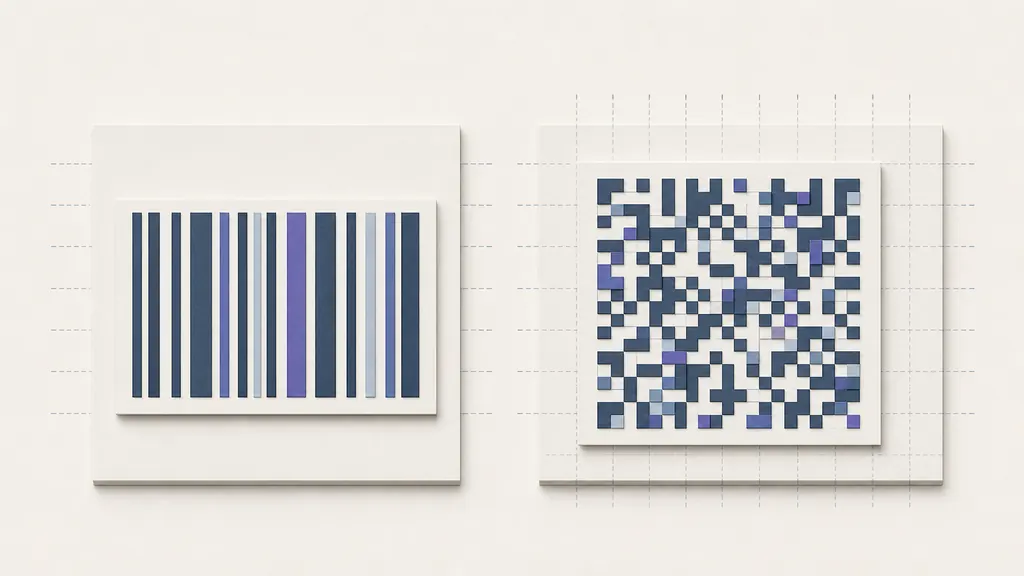
Linear formats represent data through sequences of bars and spaces and need enough horizontal width. A scanner commonly traverses the bars. Two-dimensional formats use both axes, allowing more data in a compact area but requiring an imaging reader.
QR uses three corner finder patterns. Data Matrix uses an L border. Aztec uses a center finder. PDF417 stacks barcode rows. They are all barcode formats, but their readers and application rules are not interchangeable.
Capacity and payload
UPC-A and EAN-13 carry fixed-length numeric retail identifiers. Code 128 supports printable ASCII for inventory and logistics. QR can directly hold a URL, text, Wi-Fi settings, contact information, or another structured payload. Data Matrix, PDF417, and Aztec support specialized larger or compact payloads.
More capacity is not automatically better. Longer data produces denser symbols that need more space and print quality. Encode the smallest stable value the application needs.
Reader ecosystem
Phone cameras commonly detect QR without a separate app. Retail laser and imaging scanners are configured for UPC/EAN. Warehouse readers can have Code 128 enabled and send suffix keys to host software. Industrial imagers may be optimized for Data Matrix. Ticket gates may expect Aztec or PDF417.
Ask what equipment and symbology are enabled. A phone decoding a proof does not establish compatibility with checkout, inventory, ticketing, or regulated systems.
Product identification
A retail barcode carries a product identifier that must be assigned and associated with catalog data. The image itself does not contain price or title. QRBarcode can render an authorized UPC-A or EAN-13, but it cannot issue a GTIN or register a product.
QR is not a substitute when a retailer explicitly requires a GS1 identifier. Conversely, inventing a UPC for a website link is wrong; use a QR code for consumer navigation.
Error detection and correction
UPC/EAN use a check digit to detect many transcription errors. Code 128 includes a symbol checksum. QR and other 2D formats use error correction that can recover limited damaged codewords. These mechanisms do not prove ownership, authenticity, or destination safety.
A valid symbol can contain malicious text or a copied product number. Treat decoded data as untrusted until the application validates it.
Should I use a QR code or barcode?
Use QR for phone-based URLs, menus, forms, Wi-Fi, contact sharing, and general consumer interactions. Use UPC/EAN for assigned retail identifiers. Use Code 128 for a controlled internal identifier with letters or punctuation. Use Data Matrix for compact industrial marking, PDF417 for specified stacked-document workflows, and Aztec when the receiving ticket or transport platform requires it.
If multiple audiences need different formats, print both only with clear spacing and labels. Nearby symbols can confuse users and some readers.
Print and testing
All formats need contrast, suitable dimensions, blank margins, sharp output, and final-production tests. Linear symbols should not be squeezed. QR finder patterns and quiet zones must remain clear. Two-dimensional capacity does not justify tiny print.
Use the QR code generator for consumer and structured QR payloads, or the barcode generator for the six supported non-QR formats. Test through the real receiving workflow before deployment.
Difference between QR code and barcode operations
Consumer QR deployments require a useful mobile destination, safe-link context, accessibility fallback, and ongoing URL maintenance. Retail linear deployments require authorized identifiers, catalog onboarding, print verification, and checkout testing. Inventory Code 128 needs identifier governance, reader configuration, and application validation. The optical image is only one step in each chain.
This difference between QR code and barcode operations matters when estimating cost. QR may be easy to render but expensive to maintain across changing websites. UPC artwork may be simple but identifier and retail processes are formal. Code 128 may be internally controlled but require thousands of durable labels and scanners.
Hybrid environments
A product package can legitimately carry UPC for checkout, Data Matrix for manufacturing, and QR for consumer information. Give each symbol enough quiet space and a clear purpose. Configure enterprise readers to prefer the intended format or position codes so accidental reads are unlikely.
Maintain one source record that explains every symbol and its owner. When package art changes, test all formats. A QR code vs barcode decision can therefore result in both, but only when each has a separate receiving system and the layout preserves reliable scanning.
Revisit the choice
Review after new devices, partners, payload needs, accessibility requirements, or print constraints appear. Do not migrate merely because another format has higher capacity. Change only when end-to-end tests show a measurable operational benefit and a safe transition path.
Record the QR code vs barcode decision with the receiving-system owner.